


Table of Contents
- Step 1: Choose a Personalized Gift That Travels Well
- Step 2: Understand International Shipping Customs Regulations
- Step 3: Pick the Right Carrier or Gifting Platform
- Step 4: Plan Around International Gift Delivery Timelines
- Step 5: Pack and Label the Parcel for Secure Delivery
- How to Order Bulk Personalized Gifts for Multiple Recipients
- Common Mistakes That Delay International Gift Delivery
- Frequently Asked Questions
Last Updated: September 10, 2026
Step 1: Choose a Personalized Gift That Travels Well
When you send personalized gifts internationally, the best ones are lightweight, non-fragile, and small enough to clear customs without scrutiny. If you want to know how to send personalized gifts internationally without damage or delays, the gift you choose matters more than the carrier you pick.
Custom jewelry, engraved keepsakes, and flat textiles survive long-distance transit far better than glass, ceramics, or anything perishable. At Bareluxes, we offer custom name necklaces and commemorative plaques, which are designed to be shipped with care.
Personalized gift means any item customized with a name, date, message, or photo for a specific recipient. The personalization itself rarely causes customs problems. The material and shape do.
Gift Types That Survive Long-Distance Transit
- Custom jewelry and necklaces: Lightweight, low declared value, easy to cushion.
- Engraved plaques and frames: Rigid and flat, but require corner protection.
- Personalized blankets and textiles: Compress well and resist impact.
- Photo books and prints: Flat, light, and rarely flagged at customs.
Avoid live plants, alcohol, aerosols, and perishable food. Many countries restrict or prohibit these outright, and a seized parcel means no gift at all.
Step 2: Understand International Shipping Customs Regulations
International shipping customs regulations determine whether your gift arrives in days or sits in a holding facility for weeks. Every cross-border parcel needs a customs declaration, and the accuracy of that form decides how fast it clears.
Customs authorities in the destination country assess duties and taxes based on the declared value, the item category you select, and the country's own import threshold. Marking a parcel "gift" does not exempt it from inspection, and it does not automatically waive import charges. The recipient may still owe customs duty, value-added tax, or a handling fee before delivery.
How Duty and Tax Are Actually Calculated
Most destinations calculate import charges in three steps, and understanding them lets you predict the bill before you ship:
- Duty is a percentage of the declared value plus the cost of shipping and insurance (the "CIF" value, cost, insurance, freight). Rates vary by item category; jewelry, textiles, and electronics usually carry higher rates than paper goods.
- Value-added tax or goods and services tax is then applied on top of the duty-inclusive value, not on the item price alone. This is why the final charge is often higher than senders expect.
- A carrier handling or disbursement fee is added when the courier advances the duty on the recipient's behalf. This flat fee is frequently the largest single line on a small gift.
A de minimis threshold is the value below which a country waives duty and tax entirely. The U.S. de minimis is $800 per person per day for most goods, which is why inbound gifts to American recipients rarely trigger a bill (cbp.gov). Many other countries set far lower thresholds, some as low as roughly $20 to $50, so the same $150 engraved necklace that clears free into the U.S. can generate a $40 charge in another country.
Preventing a Surprise Customs Bill for the Recipient
A recipient who has to pay to collect a gift is a bad outcome, and it is avoidable. These are the levers that work:
- Check the destination threshold first. If your declared value sits just above a low de minimis, splitting the shipment or choosing a lower-value item can keep it under the line.
- Prepay duty and tax where the carrier allows it. Several international couriers and gifting platforms offer a delivered-duty-paid option at checkout, so the charge is settled by you and never surfaces at the door.
- Tell the recipient what to expect. If a bill is likely, send them the tracking number and a heads-up so the parcel is not refused and returned.
- Keep the declared value honest but accurate. Declaring the true retail value protects insurance; under-declaring to dodge duty voids coverage and can trigger penalties.
Completing the Customs Declaration and Commercial Invoice
A customs declaration is the form listing what's inside, its value, and its purpose. A commercial invoice is the more detailed version required for higher-value or commercial shipments. For a personal gift, you typically complete the declaration; some carriers also ask for an invoice.
Fill in these fields accurately:
- Contents description: Be specific. "Necklace, stainless steel, engraved" beats "gift."
- Declared value: State the true retail value. Under-declaring can void parcel insurance.
- Purpose: Mark as "gift" only when it genuinely is one.
- Recipient information: Full legal name, complete address, and a phone number.
- Harmonized System (HS) code: A numeric code classifying the item. Your carrier or gifting platform can supply it, and an accurate code speeds clearance and prevents misclassification.
The U.S. Customs and Border Protection guidance on international mail explains what happens when a declaration is incomplete: the parcel is held, returned, or destroyed at the sender's expense.
Step 3: Pick the Right Carrier or Gifting Platform
The right carrier depends on how much tracking and speed you need versus how much you want to pay. Three broad options exist, and each suits a different kind of sender.
| Option | Best For | Tracking | Typical Speed |
|---|---|---|---|
| National postal service | Budget senders, light parcels | Basic to full | Slowest |
| International courier | Time-sensitive, high-value gifts | Full, end-to-end | Fastest |
| Gifting platform | Senders who want it handled | Full | Varies by partner |
Postal Service vs. Courier: What the Difference Costs You
The national postal service is the cheapest option for a small, light parcel, but it hands off between national networks. That handoff is where tracking goes quiet and where a parcel can sit in a foreign sorting center for a week with no update. Postal service is a reasonable choice for a low-value, non-urgent gift where a late arrival is annoying but not a disaster.
International couriers cost more but give you customs clearance support, reliable delivery confirmation, and a single tracking thread from pickup to door. For a high-value or time-sensitive gift, an anniversary piece, a client gift tied to a contract date, the premium is usually worth it because the courier acts as the importer of record and can advance duty on the recipient's behalf.
A gifting platform is a service that produces, packs, and ships the item for you, often with local production near the recipient. That model can cut transit time dramatically because the parcel never crosses a border at all. For personalized items, local production also sidesteps the customs question entirely, no declaration, no duty, no threshold to clear.
Matching the Carrier to the Gift
- Custom jewelry or small engraved pieces: Postal service for budget, courier for guaranteed tracking. Both are light enough that dimensional weight rarely bites.
- Bulky textiles or blankets: Compare postal and courier rates carefully, dimensional weight can make a courier quote far higher than expected.
- High-value or irreplaceable items: Courier only, with declared value and parcel insurance.
- Multiple recipients in one country: A gifting platform with local production usually beats shipping each parcel individually.
What to Confirm Before You Commit
For a customized item you've already ordered, confirm the carrier offers parcel insurance. Bareluxes offers optional package protection at checkout for loss, theft, and damage.
Ask three questions before you pay:
- Does the quote include duty and tax, or will the recipient be billed? A delivered-duty-paid option removes the surprise.
- Is tracking end-to-end, or does it stop at the border? Postal handoffs often break the chain.
- What is the claims window? International claims can require filing within a short period after the expected delivery date, and missing it forfeits the payout.
Step 4: Plan Around International Gift Delivery Timelines
International gift delivery timelines range from a few days to several weeks, and the variable you control least is customs clearance. Standard shipping typically takes longer than expedited shipping, but neither guarantees a date once a parcel enters a foreign customs facility.
Build your timeline backward from the occasion:
- Confirm the production or personalization time for the gift.
- Add packing and dispatch time.
- Add transit time for your chosen service level.
- Add a customs buffer, often the single largest unknown.
- Add a few days for local delivery once cleared.
For birthdays and anniversaries, ship at least three to four weeks ahead when using standard shipping. Expedited shipping shortens transit but does not skip customs.
Step 5: Pack and Label the Parcel for Secure Delivery
Secure delivery starts with packaging that survives being stacked, dropped, and re-sorted. Use a rigid outer box, cushion every side, and keep the item from shifting.
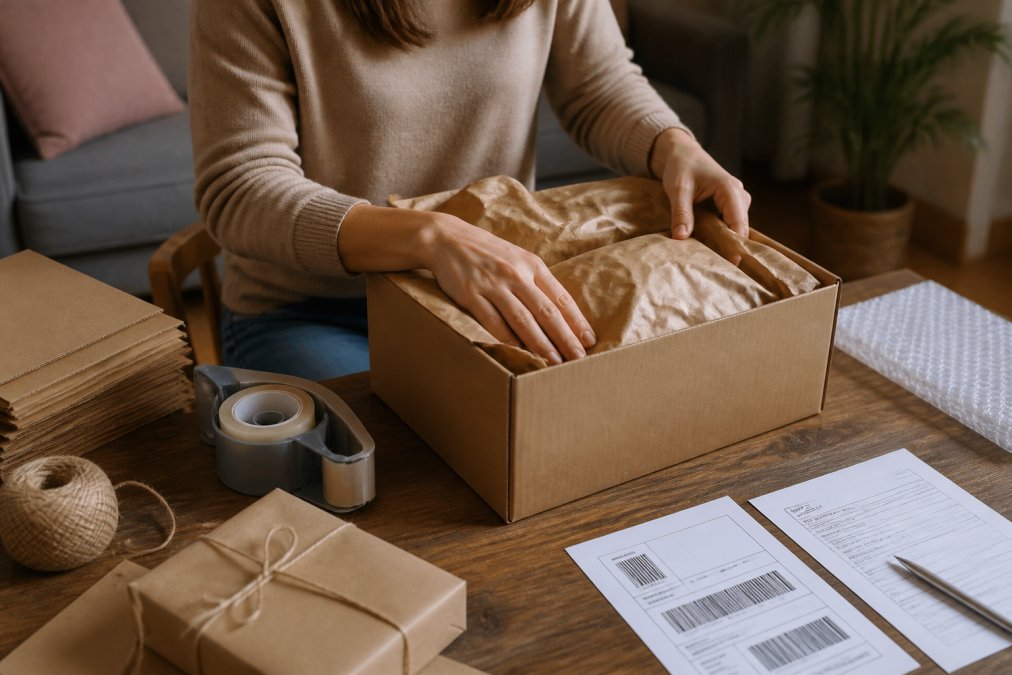
Label the parcel clearly with the recipient address in block letters, and attach the customs declaration in a clear pouch on the outside. Keep a copy of the declaration and the tracking number for yourself.
Watch package weight and dimensional weight. Carriers bill on whichever is greater, so an oversized box with a light item can cost more than a compact, heavier one. Choose the smallest box the gift fits in with cushioning.
Add a gift note inside rather than writing on the outside. A handwritten message travels better protected, and it keeps the outer packaging plain, which reduces the odds of casual theft.
How to Order Bulk Personalized Gifts for Multiple Recipients
Ordering bulk personalized gifts for multiple recipients works best when you standardize everything except the personalization. Pick one gift type, one size, and one carrier, then vary only the name, date, or message.
For a client appreciation event or a large family, this cuts per-unit shipping cost and simplifies customs paperwork, since every parcel shares the same contents description. Collect recipient addresses in a single spreadsheet with columns for name, full address, and phone number, then hand that list to your gifting partner.
Bareluxes handles multi-item orders with care, and each item can carry its own personalization. Confirm the total production window before you commit to a delivery date, because bulk orders take longer to assemble than one-off pieces.
Common Mistakes That Delay International Gift Delivery
Most delays trace back to paperwork and packaging, not bad luck. These are the errors that cost the most time:
- Vague contents descriptions. "Gift" or "accessories" invites inspection.
- Under-declared value. Saves nothing and voids insurance.
- Missing recipient phone number. Couriers need it to arrange delivery.
- Weak packaging. Fragile items arrive broken and require a claim.
- Shipping too late. No service level beats a customs hold.
- Ignoring cultural gifting etiquette. Some colors, numbers, and gift types carry meaning that varies by country, and a well-meant gift can land wrong.
A U.S. Postal Service guide to international shipping restrictions is worth checking before you seal the box, since prohibited and restricted items change by destination.
Frequently Asked Questions
What are the customs regulations for sending personalized gifts abroad?
You must complete a customs declaration listing contents, value, and whether the item is a gift. Most countries waive duties on gifts below a set threshold, but that threshold varies widely. Personalized items should be described specifically, such as 'engraved necklace,' not just 'jewelry.' Keep the declared value accurate: undervaluing a parcel to avoid fees can trigger penalties or seizure. Check the destination country's import rules before you ship, since restricted goods lists differ by nation.
How long does international gift delivery usually take?
Standard shipping typically runs 6-14 business days, while expedited options can arrive in 2-5 days, though customs clearance can add unpredictable delays. Personalized items add production time before the parcel even ships, so factor in 2-5 extra days for engraving or custom assembly. Ordering at least three weeks before a birthday or anniversary gives you a buffer. During peak seasons like December, add another week to your estimate.
Can I order bulk personalized gifts for a client event or large family gathering?
Yes, but plan ahead. Bulk orders for 20-30 items need early placement so production and packaging don't collide with your deadline. Confirm whether the seller ships each item to a separate recipient address or consolidates into one parcel, since split shipping changes both cost and customs paperwork. Ask about per-item personalization limits, and request a proof or sample before the full run. Lead times for bulk personalized orders often run longer than single-item purchases.
How do I avoid surprise duties and taxes on an international gift?
Declare the item accurately and check the destination country's gift exemption threshold before shipping. Some countries waive duties on gifts under a low value, but many do not, and the recipient often pays the fee on delivery. Use a duty calculator to estimate the landed cost upfront, then tell your recipient what to expect. Marking a parcel as a gift does not automatically exempt it from customs duty or value-added tax.
Sending a personalized gift across a border is really a test of preparation. The gift itself is the easy part; the declaration, the packaging, and the timeline decide whether it arrives intact and on time. Bareluxes designs, assembles, and ships most products from a USA factory, offers a 100% customer satisfaction guarantee, and provides optional package protection for loss, theft, and damage. Get started with Bareluxes and send a gift your recipient will actually keep.


