


Table of Contents
- Start With the Recipient, Not the Box
- Corporate Gift Set Ideas That Fit Real Budgets
- Custom Gift Box Design: Structure, Materials, and Inserts
- Personalized Corporate Gifts: Names, Monograms, and Messages
- Branded Gift Packaging: Logo Placement and Visual Style
- Test, Pack, and Ship Without Breakage
- Frequently Asked Questions
Last Updated: October 8, 2026
Start With the Recipient, Not the Box
Most people designing branded gift sets start with the box. That is backwards. The best branded gift sets begin with one question: who opens this, and what do we want them to feel? Bareluxes builds personalized gifts for families, and we have learned that the recipient, not the packaging, decides whether a gift set works.
A branded gift set is a curated group of items packaged together under one brand identity, designed to create a single memorable moment for the person receiving it. The box matters, but the person matters more.
So before you sketch anything, answer three things:
- Who is the recipient, and what is their relationship to your brand?
- What is the gift purpose: thank you, welcome, holiday, or milestone?
- What should they feel in the first five seconds?
Get those answers right and the design almost writes itself.
Match the Gift Purpose to the Occasion
Different occasions call for different tones. A client appreciation gift should feel warm and professional. A holiday gift can be playful. A milestone gift should feel weighty.
Think about the moment of opening. A busy executive wants something useful and elegant. A new employee wants something welcoming. A long-time customer wants something that says "we remember you."
Match your theme, color palette, and message to that moment. A mismatch, like a joke mug in a serious client gift, undoes the goodwill you paid for.

Corporate Gift Set Ideas That Fit Real Budgets
The best corporate gift set ideas are not the most expensive ones. They are the ones that fit your budget and still feel personal.
What most guides skip is the mechanics of cost. Per-set cost is driven by five levers, and pulling any one of them changes the others:
- Quantity. Unit cost falls as quantity rises because setup charges, printing plates, die cuts, foil stamps, insert tooling, are spread across more units. A run of 25 sets carries far more setup cost per set than a run of 500.
- Materials. A rigid chipboard box with a wrapped lid costs more than a folding paperboard carton. Recycled and certified-fiber stocks often sit between the two.
- Printing. One-color or two-color imprint on a kraft or white stock is the least expensive path. Full-color process printing, foil stamping, and embossing each add a step and a setup charge.
- Inserts. A die-cut insert that cradles each item costs more than loose tissue, but it prevents damage and makes the reveal feel intentional. Custom foam or molded pulp inserts cost more than paperboard.
- Finishing and assembly. Hand-tying ribbon, hand-packing, and hand-applying labels add labor. Machine-applied labels and pre-formed inserts cut that labor.
A practical way to plan is to set a per-recipient ceiling first, then work backward. If your ceiling is $40 per set, decide how much goes to the hero item, how much to supporting items, and how much to packaging and fulfillment.
Here is how the tiers translate into real choices:
| Budget Level | What to Include | Cost Drivers to Watch | Best For |
|---|---|---|---|
| Lean | One personalized item plus a handwritten note in a simple paperboard box | Personalization method, note printing | Large client lists |
| Mid | Two to three coordinated items in a branded box with a die-cut insert | Box material, insert tooling, two-color print | Key accounts, teams |
| Premium | A hero piece plus supporting items, rigid box, foil or embossed logo, custom insert | Rigid box, foil stamp setup, custom insert, hand assembly | Top clients, executives |
For business gifting specifically, one strong personalized piece often beats a pile of generic swag. A custom mug with a name, or a journal with a personal message, carries more weight than a logo pen.

If you are unsure where to start, price two versions of the same set: one lean, one premium. The gap between them tells you exactly what each upgrade costs, and you can decide whether the recipient will notice.
Custom Gift Box Design: Structure, Materials, and Inserts
Custom gift box design is the process of choosing a box structure, material, and interior layout that protects the items and shapes how they are revealed. Structure comes first. If the box does not hold the gift securely, nothing else matters.
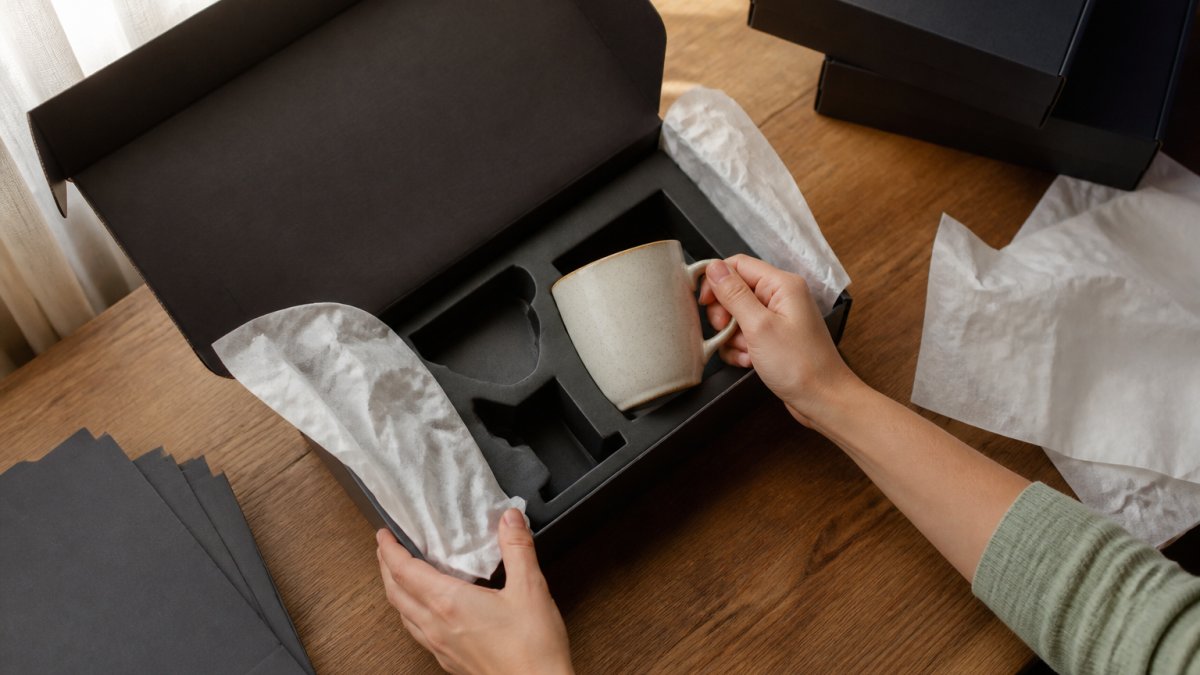
Start by measuring your items. Then add a little breathing room so nothing rattles. A custom insert, cut to match each item, keeps everything in place and makes the reveal feel intentional.
Rigid Box vs. Paperboard: What the Choice Costs You
A rigid box costs more and looks and feels more premium. A paperboard box costs less and works well for lighter items and larger runs. Choose rigid when the gift is a hero piece or a high-value client gift. Choose paperboard when you need volume and the items are light. There is no wrong answer, only a wrong match between box and gift.
Materials and End-of-Life: Recycled, Recyclable, and Reusable
Material choice is where sustainability and cost meet. Three common paths:
- Recycled paperboard. Made with post-consumer fiber, widely accepted in curbside recycling where paperboard is collected. Lower cost than rigid, good for lighter sets.
- Certified fiber. Stock carrying a recognized chain-of-custody certification signals responsibly sourced fiber. It usually costs a small premium over standard stock.
- Reusable rigid boxes. A sturdy rigid box with a magnetic closure is more likely to be kept and reused than a folding carton, which extends its life and can offset its higher upfront cost.
If you make a sustainability claim on the packaging, keep it to what the material and your local recycling stream can actually support. Vague claims like "eco-friendly" are hard to substantiate and can invite scrutiny; specific claims like "made with 100% recycled paperboard" are easier to defend.
Accessibility and Inclusive Design
A gift set that is hard to open is not a gift. A few choices make packaging work for more recipients:
- Readable typography. Use a legible typeface at a comfortable size for names, messages, and any instructions. Avoid thin, low-contrast type on busy backgrounds.
- Easy-open packaging. A pull tab, a magnetic closure, or a lid that lifts cleanly beats a tightly wedged box or a taped seam. Avoid excessive shrink wrap.
- Dietary and sensory considerations. If the set includes food or drink, offer a non-food alternative and label ingredients clearly. Avoid strongly scented items in sets that may include someone with sensitivities.
- Recipient preferences. Where you can, let recipients choose a variant, size or color, rather than guessing.
Inserts and Interior Layout
A custom insert, cut to match each item, keeps everything in place and makes the reveal feel intentional. Die-cut paperboard is the most common choice; molded pulp and foam are options when items are fragile or irregularly shaped. The insert is not decoration; it is protection.
Gift Wrap with Personalized Message →
Personalized Corporate Gifts: Names, Monograms, and Messages
Personalized corporate gifts turn a nice object into a keepsake. A name, a monogram, or a short message signals that you saw the person, not just the account.
Three personalization options cover most needs:
- Name: Clear, warm, and easy to get right
- Monogram: Elegant and compact, good for jewelry and accessories
- Custom message: The most personal, best for cards and notes
Keep messages short. A line like "Thank you for ten great years" lands harder than a paragraph.
Double-check every spelling before you order. A misspelled name turns a thoughtful gift into an awkward one, and it is the detail people remember.
Branded Gift Packaging: Logo Placement and Visual Style
Branded gift packaging is the outer and inner presentation that carries your logo, colors, and visual style without overwhelming the gift. Your logo should be present, not loud.
Placement options and when to use them:
- Lid top: Most visible, good for a clean rigid box
- Inside lid: A quiet reveal as the box opens
- Tissue or ribbon: Subtle, repeatable, flexible
- Insert card: Room for a message plus a small mark
Pick one primary placement and one secondary. More than that starts to feel like advertising instead of a gift.
Your color palette should match your brand but stay restrained. Two or three colors is plenty. A cohesive palette makes even a simple box look considered.
Printing and Finishing Techniques Worth Paying For
Not every finish is worth the cost. Here is where we would spend and where we would save.
Worth paying for:
- Foil stamping on a hero piece or premium box lid
- Embossing for a tactile, raised logo that feels expensive
- A clean, well-printed insert card
Save your money:
- Full-color printing on every surface
- Multiple finishes on one small box
- Special effects that no one will notice at arm's length
One strong finishing technique on the most visible surface beats three competing ones. If you are unsure, test a single sample before committing to a full run.
Test, Pack, and Ship Without Breakage
A gift set is only as good as its arrival condition. Test before you scale.
Run a simple pre-launch checklist:
- Order one sample and open it yourself
- Shake the closed box; listen for movement
- Drop it from waist height onto a hard floor
- Confirm the insert holds every item in place
- Check the message and spelling one final time
- Confirm your order quantity and lead time before the deadline
For fragile items, add a protective layer between the insert and the lid. For heavy items, use a rigid box and a snug insert. If you are shipping many sets, pack one exactly as you plan to ship it and inspect it after a short trip.
Frequently Asked Questions
What should you include in a branded gift set?
Build the set around one anchor item the recipient will actually use, then add one or two small supporting pieces. A ceramic mug, a vegan leather journal, or a personalized note card all work because they get used repeatedly rather than stored away. Keep the assortment to three or four items maximum. Sets that try to cover too many categories end up feeling random, and the recipient remembers the clutter instead of the brand.
How far in advance should you plan a custom branded gift set?
Personalized items add time because each piece is made to order, so it's always a good idea to build in a buffer week.
How can you personalize corporate gifts without overspending?
Pick one personalization method and apply it consistently instead of adding several. A single printed name or a short custom message costs far less than combining foil stamping, embossing, and custom inserts on every unit. You can also personalize the packaging rather than the product. Bareluxes offers gift wrap with a personalized message for $7.95, which adds a handwritten touch without changing the cost of the item inside.
What packaging works best for custom gift sets?
A rigid box with a fitted insert protects the contents and controls how everything sits when the lid comes off. Paperboard is lighter and cheaper but flexes during shipping, so it suits flat items better than mugs or anything breakable. Whichever you choose, order one sample first, pack it exactly as you plan to ship it, and drop it from waist height. If the insert holds and nothing shifts, the structure works.
Designing branded gift sets that people keep comes down to one habit: start with the person, then build the box around them. Bareluxes makes that easy with personalized gifts designed, assembled, and shipped with care, backed by a 100% customer satisfaction guarantee. From custom name pieces to cozy blankets and commemorative plaques, every order is built to honor the moment. Get started with Bareluxes and give a gift your recipient will actually remember.


