


Table of Contents
- Start With a Family Consultation Before You Sort Anything
- How to Decide Which Family Heirlooms to Keep, Sell, or Donate
- How to Catalog Family Heirlooms With Provenance and Photographs
- Build a Family Heirloom Inventory Template That Works
- How to Preserve Family Heirlooms by Material
- How to Display Family Heirlooms Without Damaging Them
- Appraisal, Insurance, and Fair Distribution Among Family Members
- Conclusion: Curation Is an Ongoing Family Practice
- Frequently Asked Questions
Last Updated: October 13, 2026
Start With a Family Consultation Before You Sort Anything
Curating a collection of family heirlooms is the process of deciding, together as a family, which inherited belongings to keep, document, care for, and pass on.
Here's the hard part most guides skip: heirlooms are emotional property before they are physical property.
So before you touch a single box, do this:
- Gather the family members who might want items, in person or on a call.
- Ask each person to name the three items they'd be heartbroken to lose.
- Write those names down. This list becomes your tiebreaker later.
- Share the family stories behind the big pieces while everyone is listening.
A common mistake is letting the loudest voice in the room decide everything. The quiet cousin who wanted the family cookbook never speaks up until it's gone.
How to Decide Which Family Heirlooms to Keep, Sell, or Donate
Sorting sentimental items works best with a clear test, not a gut feeling. Most families keep too much and store it badly. A simple framework makes the decision faster and fairer.
The Four-Question Test for Sentimental Items
Ask these four questions about every item. Two or more "yes" answers earns it a place in the collection:
- Does it carry a story we can still tell?
- Does at least one family member want it now?
- Is it in good enough condition to keep or display?
- Does it connect to a person, place, or event we want remembered?
An item with zero "yes" answers isn't trash. It's a candidate for a photo record and a respectful goodbye.
When to Sell, Donate, or Let Go
Sell when an item has real market value and no family attachment. Donate when it's useful and intact but nobody wants it. Let go when it's broken, duplicated, or tied to a relationship the family has moved past.
| Decision | Best For | First Step |
|---|---|---|
| Keep | Items with stories and willing owners | Assign a home for it |
| Sell | Valuable pieces with no family tie | Get an appraisal |
| Donate | Useful items nobody claims | Find a local charity |
| Let go | Broken or duplicated pieces | Photograph, then release |
How to Catalog Family Heirlooms With Provenance and Photographs
Cataloging is how you turn a pile of inherited keepsakes into a documented collection. Provenance means the ownership history of an item: who owned it, when, and how it came to you.
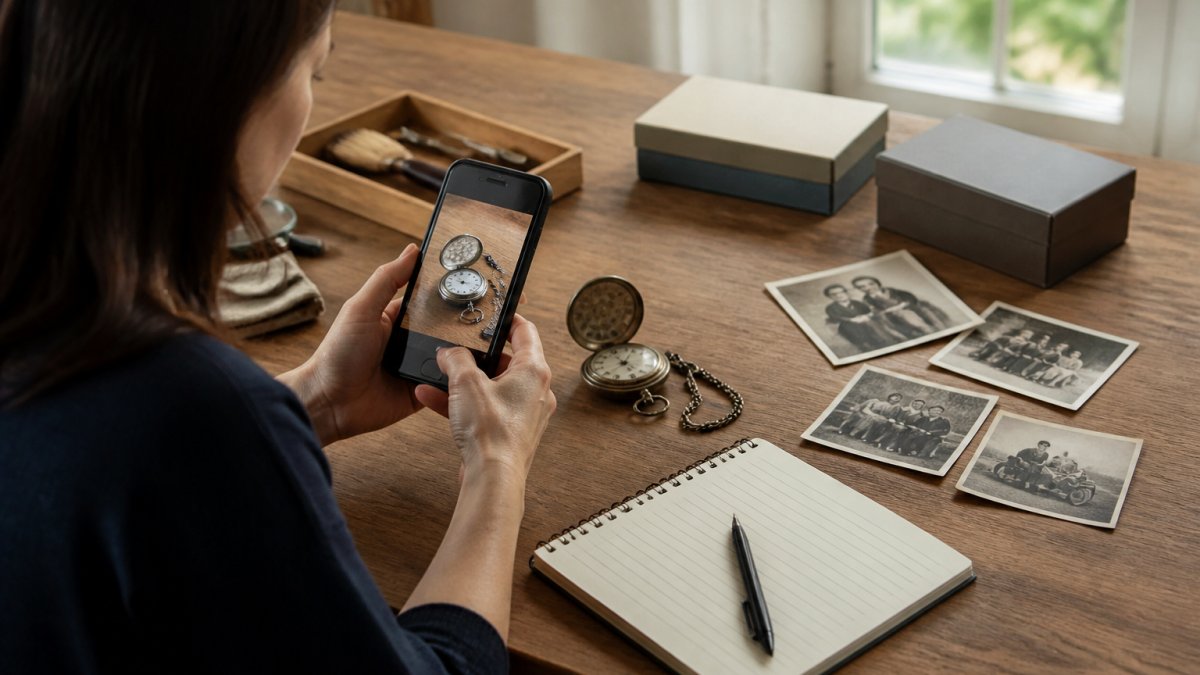
For each family heirloom, record six things:
- A clear photo from two angles
- The item's name and what it is
- Who owned it and when
The Smithsonian's guidance on documenting collections treats provenance as the backbone of any record. Family collections are no different.
Build a Family Heirloom Inventory Template That Works
A family heirloom inventory template is a simple spreadsheet or notebook that lists every item with its details, condition, and location. You don't need special software. A free spreadsheet app works fine.
Build columns for these fields:
- Item number
- Description
- Provenance notes
Number every item and stick a matching tag on it. When a cousin asks about the silver teapot, you'll know exactly where it is and what it's worth.
Digitizing Photos, Documents, and Records for the Long Term
Scan vintage photographs and paper documents at a high resolution, then save copies in two places: a cloud account and a physical drive. Label files by year and person, not "IMG_2043."
The Library of Congress tips on preserving digital files recommends refreshing your storage every few years. Technology changes faster than paper does.
How to Preserve Family Heirlooms by Material
Preservation depends on what the item is made of. Paper, fabric, metal, wood, ceramics, and mixed-media objects each fail in different ways, so treat them differently.
A few universal rules apply to everything: keep the storage area cool and stable (a common target is around 65-70°F with relative humidity near 45-55%), keep items dark, and keep them off the floor and away from exterior walls where moisture migrates.
To My Daughter - Heirloom Blanket →
Paper Documents, Letters, and Certificates
- Store flat in acid-free folders and boxes; folding cracks fibers along the crease
- Keep out of damp basements and hot attics, where humidity and heat cycle daily
- Avoid direct sunlight, which fades ink and yellows paper
Vintage Photographs
- Handle by the edges with clean cotton or nitrile gloves; skin oils etch emulsion
- Store in acid-free, lignin-free sleeves or envelopes, not sticky albums or magnetic pages
- Keep negatives and prints separate so off-gassing doesn't cross-contaminate
Textiles: Quilts, Blankets, Uniforms, and Christening Gowns
- Fold rather than hang; hanging stretches fibers and stresses seams
- Pad folds with crumpled acid-free tissue so creases don't set
- Wrap in washed, unbleached cotton or acid-free tissue, not plastic, which traps moisture and off-gasses
- Rotate folds every year or so to spread stress
Metal: Silver, Brass, and Iron
- Control humidity first, tarnish and rust are moisture-driven
- Use silver cloth or acid-free tissue; avoid rubber bands and wool, which release sulfur
- Don't over-polish silver; every polishing removes a thin layer of metal and wears away engraving
- Keep iron dry and lightly oiled with a conservation-grade product if rust is a risk
Wood: Furniture, Frames, and Carved Objects
- Keep out of direct sun and away from heating vents, which dry and crack wood
- Maintain stable humidity; swings cause joints to open and veneer to lift
- Dust with a soft cloth; avoid silicone polishes and household cleaners that build up
- Lift furniture by the frame, never by arms, legs, or a fragile back
Ceramics, Glass, and Mixed-Media Objects
- Pad shelves with closed-cell foam or acid-free batting so pieces don't slide
- Don't stack plates or cups directly; use padded separators
- For mixed-media pieces (a wooden frame with a paper photo, a textile with metal buttons), follow the most fragile material's rules and watch for interactions, metal can rust onto fabric, and acidic wood can stain paper
Archival Storage for Paper Documents and Vintage Photographs
Archival storage means materials that won't damage what they touch. Look for the terms "acid-free," "lignin-free," and "buffered" on boxes, folders, and sleeves. Keep the storage area cool, dark, and dry. Heat, light, and moisture are the three enemies of every old document. If you can only fix one, fix moisture, it does the fastest damage.
How to Display Family Heirlooms Without Damaging Them
Displaying family treasures is the reward for all that sorting. The goal is to enjoy them without speeding up their decay.
A few rules keep display safe:
- Keep items out of direct sun, which fades color and weakens fabric
- Use UV-filtering glass in frames for paper pieces
- Support heavy objects from the base, not by hanging
- Rotate displayed pieces every few months to limit light exposure
For a personal touch, a woven keepsake blanket like our To My Daughter - Heirloom Blanket lets you honor a family story in a piece you can actually use and display. It's woven from 100% cotton yarn with a colorful fringe, and it turns a meaningful image into a lasting memento.

Appraisal, Insurance, and Fair Distribution Among Family Members
This is where a curated collection becomes a legal and relational document. Most guides stop at "get it appraised" and "be fair." The practical work is more specific.
Researching Provenance Before You Appraise
An appraiser's number is only as good as the story behind the item. Before you pay for a valuation, gather what you can:
- Interview the oldest living relative who remembers the item's origin
- Look for maker's marks, hallmarks, signatures, dates, and labels, photograph them close-up
- Check the back of frames, the underside of furniture, and inside drawers for notes
- Search family papers (wills, letters, insurance riders) for the item's name
A common pattern is that two relatives remember the same object differently. Record both versions in your inventory. An appraiser or historian can sometimes settle it, but the disagreement itself is part of the provenance.
Getting a Professional Appraisal
Get a professional appraisal for anything you believe is valuable, and get it in writing. An appraiser documents an item's condition and market value, which insurers and estate planners both need.
Then check whether your homeowner's policy covers the item, or whether you need a separate rider or floater. Standard policies often cap categories like jewelry, silver, and collectibles, so a scheduled rider may be necessary.
Documenting Decisions and Consent
Fair distribution starts with consent, not with a coin flip. Use the named-want list from your family consultation, and put the outcome in writing:
- Record who received which item, the date, and the agreed value if any
- Have recipients acknowledge receipt in a simple signed note or email
- Note any items promised to someone in the future
- Keep a copy with the inventory and a copy with the estate documents
This protects everyone. A written record prevents the "I thought Mom said..." dispute years later.
A Fair Distribution Order
- Honor the written wishes in a will or trust first.
- Then the named-want list from your family consultation.
- Then let remaining family members choose in turn, rotating the order so no one picks first every time.
- For items two people want equally, consider rotating ownership, shared display, or a buy-out where one pays the other half the appraised value.
- For items nobody wants, photograph them, offer them to extended family, then donate or sell.
The IRS guidance on estate and gift taxes is worth reviewing before you transfer high-value items. Rules change, so confirm current details with a tax professional.
Conclusion: Curation Is an Ongoing Family Practice
The real challenge isn't sorting one closet. It's keeping the stories alive for the next generation, and that takes a little care every year. Bareluxes helps families turn sentimental moments into lasting keepsakes, from personalized blankets to custom pieces designed, assembled, and shipped with care. Our products carry a 100% customer satisfaction guarantee, and every order is packaged to be cherished for a lifetime.
Frequently Asked Questions
What makes a family heirloom worth keeping?
An item earns heirloom status through provenance, the documented ownership history that ties it to a specific person or moment. A plain wooden spoon from a great-grandmother's kitchen can carry more weight than a valuable antique with no story. Ask whether the item connects living family members to a shared memory, whether anyone wants to inherit it, and whether you can store or display it responsibly. Sentimental value, not monetary value, usually decides what stays.
How do you decide which family heirlooms to keep?
Run each item through four questions: Does it have documented provenance? Does a family member actively want it? Can you preserve it properly? Does it represent a person or era the family cares about? Items that fail all four are candidates to sell, donate, or photograph and release. Keep the group small enough that every piece gets proper care, and let family members weigh in before you decide alone.
How should you catalog family heirlooms?
Photograph each item from multiple angles, then record its description, condition, provenance, and current location in a shared spreadsheet or inventory template. Note dimensions, materials, and any inscriptions. Store digital copies in cloud storage plus an external drive, and give one family member a printed backup. A catalog of family heirlooms only works if heirs can find it, so share access with at least two relatives.
How do you preserve and store family heirlooms?
Match the storage method to the material. Paper documents and vintage photographs belong in acid-free folders inside a cool, dry closet away from moisture, heat, and direct light. Textiles go in clean cotton or acid-free tissue, folded with padding at the creases. Metals and wood do best in stable humidity with a light dusting routine. Avoid attics and basements, where temperature swings and dampness cause the most damage.


