


Table of Contents
- Belviaggio Designs vs Custom Gift Shops: Quick Comparison
- How to Choose a Custom Jeweler: 6 Criteria That Matter
- Jewelry Customization vs Ready-Made: Which Fits Your Occasion?
- Personalized Jewelry Alternatives That Hold Their Value
- Pricing Breakdown: What You Actually Pay at Each Option
- Caring for Custom Jewelry: Maintenance and Long-Term Value
- Frequently Asked Questions
Last Updated: September 14, 2026
Belviaggio Designs vs Custom Gift Shops: Quick Comparison
Belviaggio Designs and custom gift shops sit at opposite ends of the personalized jewelry market. Belviaggio is a boutique studio built around bespoke design consultations and made-to-order fine jewelry. Custom gift shops engrave or assemble pre-made items quickly, often at lower price points. This guide from Bareluxes compares the two on materials, turnaround, pricing, and long-term value.
The distinction matters more than most buyers expect. A bespoke studio walks you through gemstone selection, precious metals, and CAD rendering before a single piece is cast. A custom gift shop takes a stock pendant, adds a name, and ships it within days.
| Factor | Bespoke Studio | Custom Gift Shop |
|---|---|---|
| Design process | Consultation, CAD rendering | Template selection |
| Materials | Precious metals, certified stones | Plated or stainless options |
| Turnaround | Weeks | Days |
| Price range | Higher, reflects labor | Lower, reflects volume |
| Best for | Milestone occasions | Quick, casual gifting |
How to Choose a Custom Jeweler: 6 Criteria That Matter
Choosing a custom jeweler comes down to six criteria: design consultation depth, material sourcing, production standards, turnaround time, pricing transparency, and after-sale support. Most buyers weight only price and speed, then regret it when the piece tarnishes or the sizing is off. The Jewelers of America buyer guidance recommends asking directly about metal content and stone certification before committing.
Here is what to verify:
- Design consultation: Does the jeweler offer a real conversation, sketches, or CAD rendering, or just a dropdown menu?
- Material sourcing: Are metals solid or plated? Are stones certified and traceable?
- Production standards: Is the piece handcrafted in-house or outsourced?
- Turnaround: What is the realistic timeline, not the marketing estimate?
- Pricing transparency: Are setting fees, engraving, and shipping itemized?
- After-sale support: Is there resizing, repair, or a warranty?
A boutique studio will answer all six without hesitation. A gift shop may only address two or three.
Materials, Finishes, and What They Cost You Long-Term
Materials decide whether a piece survives a decade. Solid gold and stainless steel hold up; plated finishes wear through at friction points within a year or two of daily wear (Buying Platinum, Gold, and Silver Jewelry). Certified stones and lab-grown diamonds carry documentation that protects resale value. Ask for the metal's karat or grade in writing, and confirm whether the finish is plated or solid.
Turnaround Times and Production Standards
Turnaround times separate the two models sharply. A bespoke studio needs several weeks because the piece is cast, set, and polished to order. A custom gift shop ships in days because nothing is made from scratch. If your anniversary is next week, that speed is worth something; with a month, the studio's extra time buys better craftsmanship.
Jewelry Customization vs Ready-Made: Which Fits Your Occasion?
Jewelry customization fits milestone occasions; ready-made fits spontaneous gifting. The real decision is whether the piece is built around a person or selected for them, a distinction that drives the design process, timeline, and price.
Here is how the two paths diverge in practice:
- Custom / bespoke path: You start with a consultation, move to sketches or CAD (computer-aided design) renderings, approve a wax or resin model, then the piece is cast, set, and polished. The recipient's preferences, metal tone, stone shape, chain length, engraving font, are inputs, not afterthoughts.
- Ready-made path: You choose from a catalog, optionally add a name, date, or symbol, and the item ships. Personalization is a layer applied to a finished design.
- Hybrid path: Many made-to-order studios sit between the two. You pick a proven silhouette (a name necklace, a signet ring, a birthstone pendant) and customize one or two variables, characters, finish, chain length. It is the fastest route to something personal.
Consider how the recipient will use the piece:

- Daily wear: Solid metals, secure clasps, simple silhouettes. A plated finish on a piece worn every day will show wear at friction points, the clasp, the chain-to-pendant joint, the back of a ring, within a year or two.
- Special occasions: Statement stones, custom engraving, heirloom intent. These justify the longer bespoke timeline because they are worn a few times a year.
- Sentimental keepsakes: Names, dates, or symbols that carry meaning. A single customization field (a name, a set of initials) can produce dozens of distinct designs depending on font, orientation, and finish.
- Trend-driven gifts: Lower-cost pieces that can be replaced. There is nothing wrong with this category, it just should not be confused with an heirloom purchase.
A practical way to decide: ask whether the recipient would notice if the piece were swapped for a similar one. If no, ready-made is fine. If yes, because the name, date, or specific design is the point, you are in customization territory.
What the Customization Process Actually Looks Like
A true bespoke commission moves through five stages: consultation, design rendering, model approval, production, and final inspection. Each is a checkpoint where you can change direction before money is committed to metal and stones. A made-to-order studio compresses this to two stages, selection and personalization, which is why the timeline is shorter and the price lower.
The trade-off is design freedom. In a bespoke commission you can specify a stone's cut, a metal's alloy, and a setting style. In a made-to-order model you choose among options the studio has already validated for durability and cost. For most gifts, made-to-order fits better because the engineering problems are already solved.
Matching the Piece to the Relationship and the Budget
A common pattern is to spend more on pieces tied to a milestone (a wedding, a birth, a significant anniversary) and less on pieces tied to a calendar event (a birthday, a holiday). That is not stinginess, it is matching the durability of the object to the duration of the meaning.
If you are unsure which path fits, start with the budget and work backward. A made-to-order name necklace in solid stainless steel or gold finish typically lands in the tens of dollars. A fully bespoke piece with certified stones and precious metal lands in the hundreds or more, because you pay for design time, material weight, and stone grading. Knowing your ceiling before the consultation prevents an awkward mid-process pivot.
Personalized Jewelry Alternatives That Hold Their Value
Personalized jewelry alternatives that hold value share three traits: solid precious metals, certified stones, and timeless design. Name necklaces in polished stainless steel or 18K yellow gold finish, for example, resist tarnishing and suit everyday wear far better than plated costume pieces. The Federal Trade Commission guidance on jewelry marketing requires sellers to disclose plated versus solid metals, so read the product description carefully.
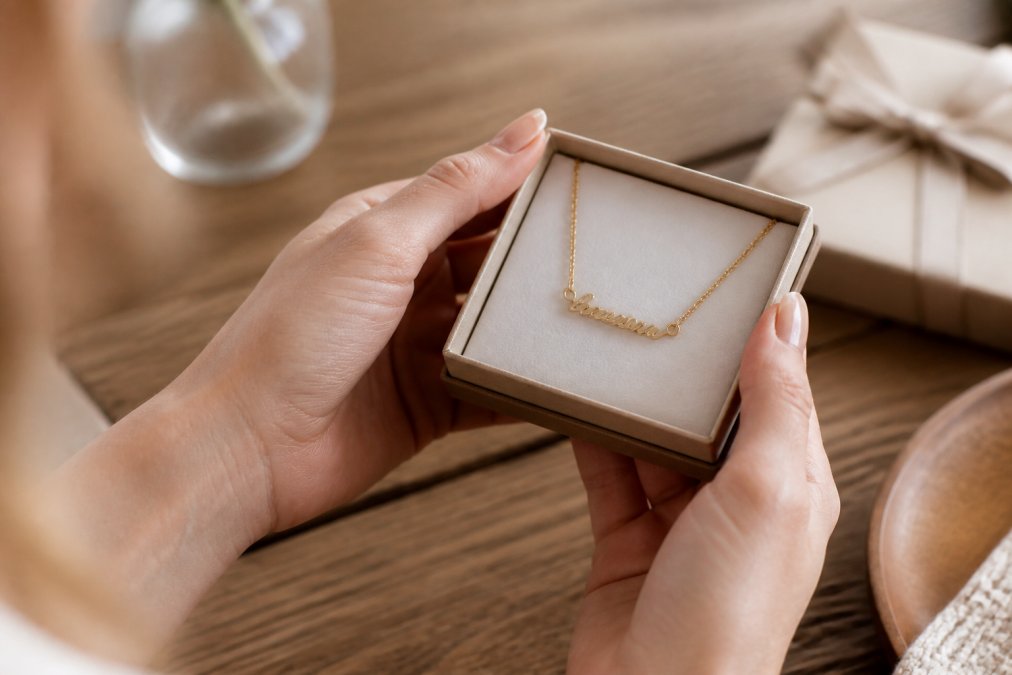
Bareluxes offers a range of made-to-order name necklaces that sit in this category. The Classic Heart Style Name Necklace is finished in polished stainless steel or 18K yellow gold. It is designed, assembled, and shipped from a USA facility.
Name Necklaces and Keepsake Pieces Compared
Name necklaces and keepsake pieces differ mainly in design flexibility. A cursive name pendant personalizes one element; a keepsake piece can combine names, dates, and symbols. Both work as wedding jewelry or anniversary gifts, but keepsake designs carry more meaning and cost more to produce. The Classic Vertical Name Necklace and the Signature Style Name Necklace show how much variety a single customization field can produce.

Pricing Breakdown: What You Actually Pay at Each Option
Pricing at a bespoke studio reflects labor, materials, and consultation time. Pricing at a custom gift shop reflects volume and template efficiency. A studio piece can cost several times more than a comparable retail item, and the gap is not automatically overcharging, you are paying for design work and materials, not just the finished object.
What most guides skip is how the price is actually built, the part that helps you negotiate, budget, and avoid surprises.
| Cost Component | Bespoke Studio | Custom Gift Shop |
|---|---|---|
| Design and consultation | Included in price | Not offered |
| Metal and stones | Priced by weight and grade | Fixed, often plated |
| Engraving or personalization | Quoted per piece | Often bundled |
| Shipping and packaging | Varies | Often free or flat rate |
| Resizing or repair | Commonly offered | Rarely offered |
How the Price Is Actually Built
A custom piece's price is the sum of four inputs: metal cost (by weight and alloy), stone cost (by carat, cut, color, and clarity), labor (design hours plus bench time), and overhead (studio, insurance, packaging). Ask for those four lines separately, a studio that itemizes is easier to compare against a gift shop than one quoting a single number.
A gift shop's price is built differently. Because the base item is manufactured in volume, the per-unit cost of the blank is low. Personalization, engraving, a name plate, a birthstone, is added as a service, and the margin comes from volume and that fee, not the metal.
That is why a $40 name necklace and a $400 bespoke pendant can look similar in a photo but behave very differently over ten years. The first is priced to be replaced; the second is priced to be kept.
Cost-Per-Wear: The Comparison Most Buyers Miss
A useful reframe is cost-per-wear. A piece worn daily for five years has roughly 1,800 wear days. A $400 bespoke pendant works out to about 22 cents per wear. A $40 plated piece that tarnishes in 18 months and is replaced twice works out to a similar or higher figure, plus the hassle.
This is not an argument that every purchase should be bespoke, only that the sticker price is not the whole cost. Factor in replacement frequency, replating fees, and whether the piece survives to be handed down.
Payment Plans and Financing Options
Financing is where the two models diverge sharply.
- Bespoke studios commonly offer layaway or installment plans because the production timeline is weeks or months. A typical structure is a deposit to begin design, a second payment at model approval, and a final payment before shipping. Some partner with third-party financing providers.
- Custom gift shops rarely offer financing because the transaction is small and immediate, usually a single card charge at checkout.
- Made-to-order studios sit in between: no formal financing, but the lower price point means the question rarely comes up.
Before committing to a payment plan, ask three questions: Is there interest or a fee? What happens to the deposit if you cancel after design work starts? Is the final payment due before or after you see the finished piece? Get the answers in writing.
Bareluxes name necklaces start at $39.95, with the vertical style at $54.95. Each piece arrives in a complimentary soft-touch box, with an optional mahogany-style luxury box available for gifting. At that price point, the cost-per-wear math favors made-to-order over both disposable fashion jewelry and full bespoke commissions for everyday pieces.
Caring for Custom Jewelry: Maintenance and Long-Term Value
Custom jewelry lasts decades when cleaned and stored correctly. Plated pieces need gentler handling than solid metals because the finish is the fragile layer. A simple routine keeps both looking new.
- Remove jewelry before swimming, showering, or applying lotion
- Wipe with a soft dry cloth after each wear
- Store pieces separately in a lined box to prevent scratching
- Clean solid metals with mild soap and warm water
- Have clasps and settings inspected periodically
A jewelry appraisal documents what you own for insurance. For pieces with certified stones or significant metal weight, it is worth the fee. For everyday name necklaces, a receipt and photos usually suffice.
Choosing between a bespoke studio and a custom gift shop gets easier once you match the purchase to the occasion. For meaningful milestones, Bareluxes offers made-to-order name necklaces designed, assembled, and shipped from a USA facility, backed by a 100% customer satisfaction guarantee. Explore the Classic Style Name Necklace or the Classic Paw Print Name Necklace and give a piece built to be kept. Get started with Bareluxes and turn a name into a keepsake.

Frequently Asked Questions
Is it cheaper to have jewelry custom made than buying from a designer?
Custom-made jewelry often costs less than designer pieces because you skip brand markups and retail overhead. A custom name necklace from a small studio can start around $39.95, while comparable designer pieces frequently run several hundred dollars. The trade-off is that you wait longer for production and have fewer return options. For sentimental gifts, custom work usually delivers more personal value per dollar spent.
What should I look for when choosing a custom jewelry shop?
Check four things: material specifications (stainless steel, 18K gold finishes, clasp type), production location, turnaround time, and the return policy. Ask whether pieces are made in-house or outsourced, since that affects quality control. A shop that publishes exact specs, like chain length and clasp size, is usually more transparent than one that only shows lifestyle photos. Read the satisfaction guarantee carefully before ordering.
How long does it typically take to receive a custom-made piece of jewelry?
Most custom pieces ship within 5 to 15 business days after you approve the design. Simpler items like engraved name necklaces often move faster than fully bespoke rings with CAD rendering and stone setting. If you need a gift by a specific date, order at least three weeks ahead and confirm the production timeline before checkout. Rush options exist but usually cost extra.
Are custom-made gifts better for special occasions than mass-produced items?
Custom gifts carry personal meaning that mass-produced items cannot match, which matters for anniversaries, birthdays, and milestones. A personalized name necklace or keepsake piece signals effort and thought. Mass-produced gifts work fine for casual exchanges or corporate bulk orders where consistency matters more than sentiment. For family milestones, most gift-givers find custom pieces are worth the extra planning time.
How does the quality of a boutique custom jewelry studio compare to general custom gift shops?
Boutique studios typically control more of the production process, which means tighter quality checks on finishes, clasps, and engraving. General gift shops often resell mass-produced blanks that get personalized after the fact. The difference shows up in details: a 9mm lobster clasp versus a flimsy spring ring, or a polished 18K gold finish versus a thin plating that wears off. Ask about materials and production methods before buying.


